Marbella upgrades 32 of its 60 traffic light junctions to the new traffic rules and warns of effects on mobility
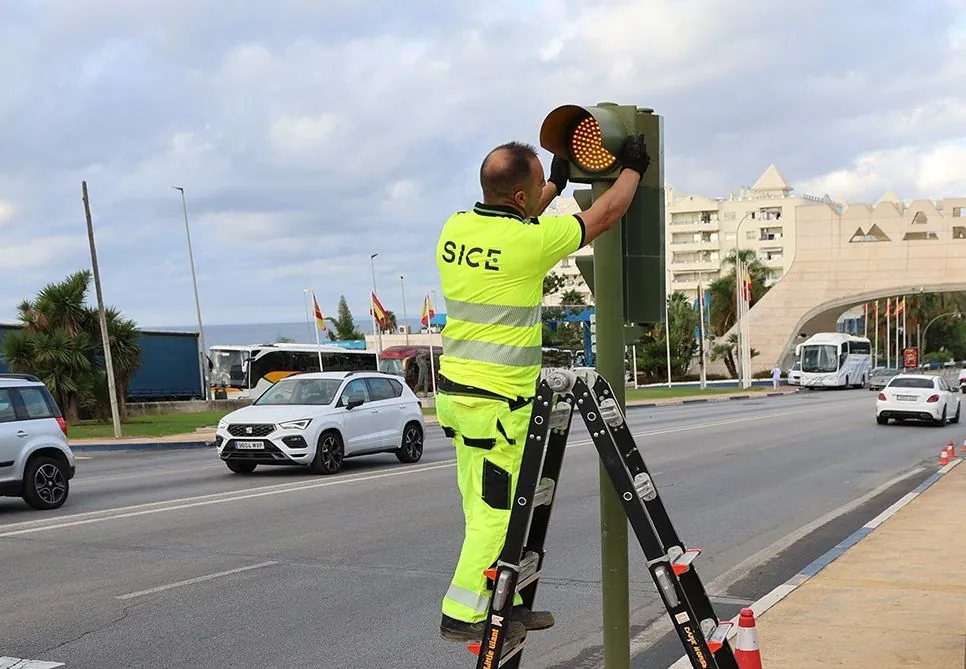
The works, costing around 100,000 euros and running until the end of November, require controllers to be reprogrammed, light units replaced and the overlap between flashing amber for cars and green for pedestrians rethought. The council shares the safety aim but fears longer waits at saturated junctions.
Translated from the Spanish original. Leer en español
More than half of Marbella's signal controlled junctions are being adapted. The council is working on 32 of the municipality's 60 regulated intersections to comply with the amendment to the General Traffic Regulations approved by the central government, in force since 1 October. The work will run until the end of November and will cost the municipality approximately 100,000 euros, according to the council note, whose figures are also reported by Informa Málaga.
The technical scope varies by junction. At 16 intersections it is enough to reprogramme the traffic light controllers, while at the other 16 parts of the installation must also be modified. More than 300 individual traffic lights are affected in total. The junctions named by the council include Calle Serenata with Avenida San Bernabé, Avenida Julio Iglesias with Calle Antonio El Bailarín, Avenida Salamanca with Avenida de Burgos and Calle José Echegaray with Calle Lyon.
The change: flashing amber no longer overlaps with the pedestrian green
The substantive change is about how the seconds are shared. Until now, at many crossings the flashing amber for vehicles coincided with a steady green for pedestrians, a combination that allowed drivers to proceed with caution when nobody was crossing, while always remaining obliged to give way. As a general rule, the new regulations prevent the two signals from coinciding and require the flashing amber to be preceded by a steady red phase for cars.
The solution being applied keeps vehicles at red during the steady pedestrian green and then allows the flashing amber to coincide with a flashing pedestrian green, with phase lengths adjusted to each junction. The council reminds drivers that at a flashing amber they must take extra care and respect the priority of people crossing.
The council's warning: longer waits and an added risk
The council says it shares the aim of protecting the most vulnerable road users, but considers that limiting this combination across the board may lengthen waiting times and slow traffic, because vehicles will be held even when no pedestrian is crossing, above all at the most saturated junctions. It also warns of a mirror effect for people on foot: depending on each junction's configuration, redistributing the cycles may shorten the steady pedestrian green or lengthen the wait for the next turn, with the risk that some pedestrians cross improperly on red.
There is also a later clarification. The Directorate General of Traffic has explained in a recent instruction that the limitation is the general rule rather than an absolute prohibition, and that it allows exceptions at certain intersections. The council argues that implementation should reflect the technical and safety circumstances of each site, which is why its technical services and the contractor are analysing every junction together with its neighbours, since any change can affect nearby intersections and journey times, including those of public transport.
What is being installed by the end of November
The works package includes fitting 43 new three aspect traffic lights of 200 millimetres in diameter, installing 16 peripheral modules and 26 output cards, and laying 3,729 metres of cable. The LED pedestrian optics with countdown devices number 129, and at 18 of the junctions those countdown devices themselves will be adapted so that the time they display matches the new programming. The council stresses that the countdown is a supplementary reference for someone already crossing the road and does not replace the light signals themselves.
The work will continue in stages until the end of November, with the stated aim of meeting the state requirements while preserving pedestrian safety and minimising the effects on mobility in the municipality.